
CNC Machining, CAD & Hybrid Turbo Development
At the beginning of 2026, we made the move into Unit 9 at our premises. This time, it wasn't for a Dispatch Department or Body Shop, but for something crucial to the continued growth of Darkside Developments — our very own Engineering Department, incorporating CNC machining, hybrid turbo development, CAD and 3D printing.
With a team of around six employees specialising in CAD (Computer-Aided Design), CNC machining, turbo development and automotive engineering, this expansion has opened up new opportunities for the future development of Darkside products, project cars and motorsport.
Having our own Engineering Department gives us greater flexibility with our products, more freedom to develop new ideas and, most importantly, the ability to say, "Sure, we can do that."
CNC Machining & Precision Engineering
CNC Milling
By early summer 2026, our brand-new SYIL X9 3-Axis CNC Machine was up and running. This was one of the largest pieces of the puzzle for Unit 9 and lays the foundation for the future of product manufacturing at Darkside Developments.
No longer having to rely entirely on external machinists is a huge step forward for us. With the assistance of our CAD team, we have removed a significant bottleneck that could previously lead to longer lead times, supply issues and difficulties replacing obsolete components.

Alongside the benefits for our existing products, this machine allows us to go further than ever before with prototyping and product development.
A component can progress from a 3D scan, through CAD design and a 3D-printed prototype, before moving onto the CNC machine and eventually being fitted to our test vehicle. Keeping these processes in-house dramatically reduces the time required to turn an idea into a physical, testable component.
Key machine specifications:
- Axis Travel (X × Y × Z): 760 mm × 500 mm × 500 mm (approx. 29.9" × 19.7" × 19.7")
- Spindle: 10,000 RPM CT40/BT40 spindle delivering around 22–23 hpTool Changer:
- 24-pocket high-speed servo arm-type tool changer
- Linear Motion: THK high-precision linear guides and high-precision ball screwsMachine
- Frame: Schneeberger mineral casting / epoxy granite bed
- Controller: Siemens SINUMERIK 828D
Arrival Day: Watch as our SYIL X9 is installed and we get the basic rundown from Pat at SYIL.
One-Off & Production Machining
Having our own Engineering facility means we can now offer one-off machining without relying on external subcontractors and the additional lead times that can come with them.
This is particularly important for our Motorsport division, where our race cars may require a unique solution that simply isn't available to purchase elsewhere. When this happens, there is often a sense of urgency to design and manufacture the required component before the next race day.
With our Engineering Department now located just across the yard from the Race Workshop, we can drastically reduce downtime and turn around new or revised components far more quickly.
As well as one-off machining, we have also begun moving production of our regular billet components away from external suppliers and towards completely independent, in-house manufacturing.
Our main priority is always our customers, and we aim to dispatch online orders as quickly as possible. Being able to replenish stock ourselves significantly reduces our reliance on external lead times and gives us greater control over production and stock availability.

Materials We Machine
We machine a wide range of materials, from 6000-series aluminium through to 316L stainless steel. The material selected depends entirely on the component, its intended use and the mechanical properties required for the application.
Some of the materials we stock and work with include:
- 6000-Series Aluminium: versatile family of heat-treatable aluminium alloys using magnesium and silicon as their primary alloying elements. Commonly suited to components that may also require fabrication or welding.
- 7000-Series Aluminium: family of high-strength aluminium alloys containing zinc as the primary alloying element, often alongside magnesium and copper. Frequently used for demanding performance and motorsport applications where high strength is required.
- 316L Stainless Steel: durable stainless steel containing chromium, nickel and molybdenum. Used extensively within our exhaust and fabrication work due to its strength and corrosion resistance.
- 304 Stainless Steel: widely used grade of stainless steel containing iron, chromium and nickel, known for its versatility and corrosion resistance.
- EN24 Steel: high-strength alloy steel containing nickel, chromium and molybdenum, making it suitable for high-tensile applications such as studs, bolts and other highly loaded components.
Hybrid Turbo Development
Since 2024, we have been developing and producing our own hybrid turbochargers in-house for a growing range of applications.
Our dedicated turbo room was established after we made the decision to invest in the equipment required to professionally build, balance, machine and flow-test turbochargers here at our facility.
Bringing these processes in-house gives us far greater control over development, production and quality while also allowing our Turbo, CNC, Workshop and Tuning teams to work closely together.

What Is a Hybrid Turbo?
A hybrid turbocharger is based around an original turbo platform but incorporates upgraded or modified components to increase its performance capability.
Depending on the application, this can include a larger compressor wheel and, in some cases, an upgraded turbine wheel. The turbocharger is completely stripped and rebuilt, with modifications such as precision machining of the compressor housing and seal plate carried out where required to accommodate the larger billet compressor wheel.
One of the main advantages of a hybrid turbo is that the original turbocharger platform and mounting arrangement can often be retained, allowing significantly increased performance capability while maintaining fitment suited to the original application.
Alongside our Tuning and Workshop departments, we are able to fit, test and gather data from our own hybrid turbo prototypes in-house before releasing them to customers.
This gives us a much clearer understanding of how the turbocharger performs, where improvements may be required and what customers can realistically expect when installing a Darkside hybrid turbocharger as part of the correct supporting setup.

Hybrid Turbo Design & Development
We often begin development of new hybrid turbochargers in response to demand from our customers and the wider enthusiast community.
Fortunately, Darkside has plenty of enthusiasts within the team itself, giving us access to staff cars, project vehicles and development cars that can provide ideal platforms for testing new applications. Because hybrid turbochargers retain much of the original turbo platform, they can also offer a cost-effective performance upgrade compared to a brand new stock replacement unit.
Many of our hybrids are produced using suitable used turbocharger cores. These are thoroughly cleaned and refurbished using our rotary, tumble and blasting equipment before being inspected and rebuilt. New components are installed where required, with upgraded components such as billet hybrid compressor wheels used depending on the intended specification.
Some of our most popular hybrid turbo products include:
- BMW F Series 35d / 40d Performance Hybrid Bi-Turbo
- 52mm Hybrid for US Spec CJAA / CBEA CR140 2.0 TDI CR Engines
- GT1752 Hybrid for Mk4 Platform 1.9 PD 8v TDI
- VAG 3.0 TDI V6 GTB2566VK Hybrid Turbocharger
- GTA1856VK Hybrid Set for VW Touareg 5.0 V10 TDI
Turbocharger Housing Machining
Machining plays a major role in the production of our hybrid turbochargers.
Installing a larger compressor wheel also requires the compressor housing and seal plate to be precisely machined to provide the required fit and operating clearances.
With our own CNC machining capabilities, we can now carry out more of this process ourselves. Using the dimensional data and CAD profiles for the hybrid compressor wheels, we can determine how much material needs to be removed before accurately and repeatedly machining housings for production batches.
This is another key advantage of having our Turbo Development and CNC Machining departments working side by side.

Turbocharger Rebuilding
We don't just manufacture hybrid turbochargers; we also offer complete turbocharger rebuilding and reconditioning.
Over the years, particularly with older vehicles, we have seen original turbochargers become increasingly difficult to source or completely obsolete while demand for replacement units still remains.
Having the facilities and experience to rebuild these units allows us to offer another solution. Depending on the condition and availability of components, rebuilding an existing turbocharger can also provide a more cost-effective alternative to purchasing a brand-new replacement unit.
Our ability to clean, inspect, machine, rebuild and balance turbochargers in-house also supports the continued development of our own hybrid range.
CAD Design & Product Development
3D Scanning & Reverse Engineering
Many of our products begin as reverse-engineered upgrades to existing components. Before a new design can begin, we first need an accurate understanding of the original component, its mounting points and the surrounding space available within the vehicle.
Using our handheld infrared 3D scanners, we can capture highly detailed digital representations of both the component itself and the surrounding area. This scan data can then be transferred to our CAD team, giving them an accurate reference from which to begin developing the first design.
This process is especially useful when working with complicated shapes or restricted spaces that would otherwise be difficult and time-consuming to measure accurately using traditional methods.
Watch as we scan our Audi A2 in preparation for future track upgrades:
Prototyping & 3D Printing
Creating an initial prototype is an essential part of developing many new products.
Once the first CAD design is ready, we have the ability to produce a physical prototype using our 3D printers. This allows us to test fitment, check clearances and identify potential design changes before committing the time and material required to machine the final component.
Over the years, we have 3D printed a huge variety of prototypes, including exhaust manifolds, turbocharger housings, engine components and even a complete 02Q 6-speed gearbox assembly for development purposes.

Our use of 3D printing doesn't stop at prototyping.
A number of our finished products and kit components are manufactured within our 3D Printing Room, including air ducts, light controller mounts, snorkel components, support brackets and more.
The range of engineering filaments available to us makes this possible, including materials such as PET-G and ASA-CF, which can provide useful combinations of strength, durability and environmental resistance depending on the application.

Our CNC & Engineering Equipment
Our Engineering Department currently includes:
- SYIL X9 VMC
- Bianco Bandsaw
- 8 × Bambu Lab 3D printers
- Raise Pro+ 3D printer
- FlashForge 3D printer
- Senfeng laser engraver
- Einstar 3D scanner
- EinScan 3D scanner
- Peel 3D scanner
- FARO Arm
Our Turbo Development Equipment
Our dedicated Turbo Development facilities include:
- G3 Flow Bench
- CIMAT VSR Balancing Machine
- Rotary and tumble blasting machines
Internal Workflow
Engineering Working With Fabrication
For more than 15 years, we have been fabricating our own downpipes, exhaust systems, intercoolers and other performance components in-house.
CNC-machined components often form an important part of these fabricated assemblies, including flanges, bosses, brackets and other precision parts.
Previously, many of these components had to be sourced from external suppliers. With our own CNC machining capabilities, they can now be designed by our CAD team, machined in Unit 9 and passed directly across to Fabrication for assembly.
Keeping these processes in-house allows us to design, develop and manufacture products more efficiently while maintaining greater control over the finished component.

Engineering Working With the Workshop
We regularly encounter vehicles in our workshop that require bespoke components or engineering work to suit a particular customer's requirements.
This could be a big brake kit requiring a new caliper bracket, or an engine component with a known factory weakness where simply installing another standard replacement may not be the best long-term solution.
With our Workshop, CAD and Engineering teams all on the same site, we can work together to investigate the problem, design an appropriate solution and manufacture a revised component where required.
This combination of real-world workshop experience and in-house engineering allows us to turn problems discovered on vehicles into potential solutions and, in some cases, entirely new Darkside products.

Motorsport Development & Testing
As active competitors within 750 Motor Club motorsport, we are constantly looking for ways to develop and improve our race cars.
Whether this means producing a new 3D-printed air duct, developing a hybrid turbocharger, designing spoiler brackets or creating new aerodynamic components, our Engineering Department gives us the ability to turn ideas into physical parts quickly and efficiently.
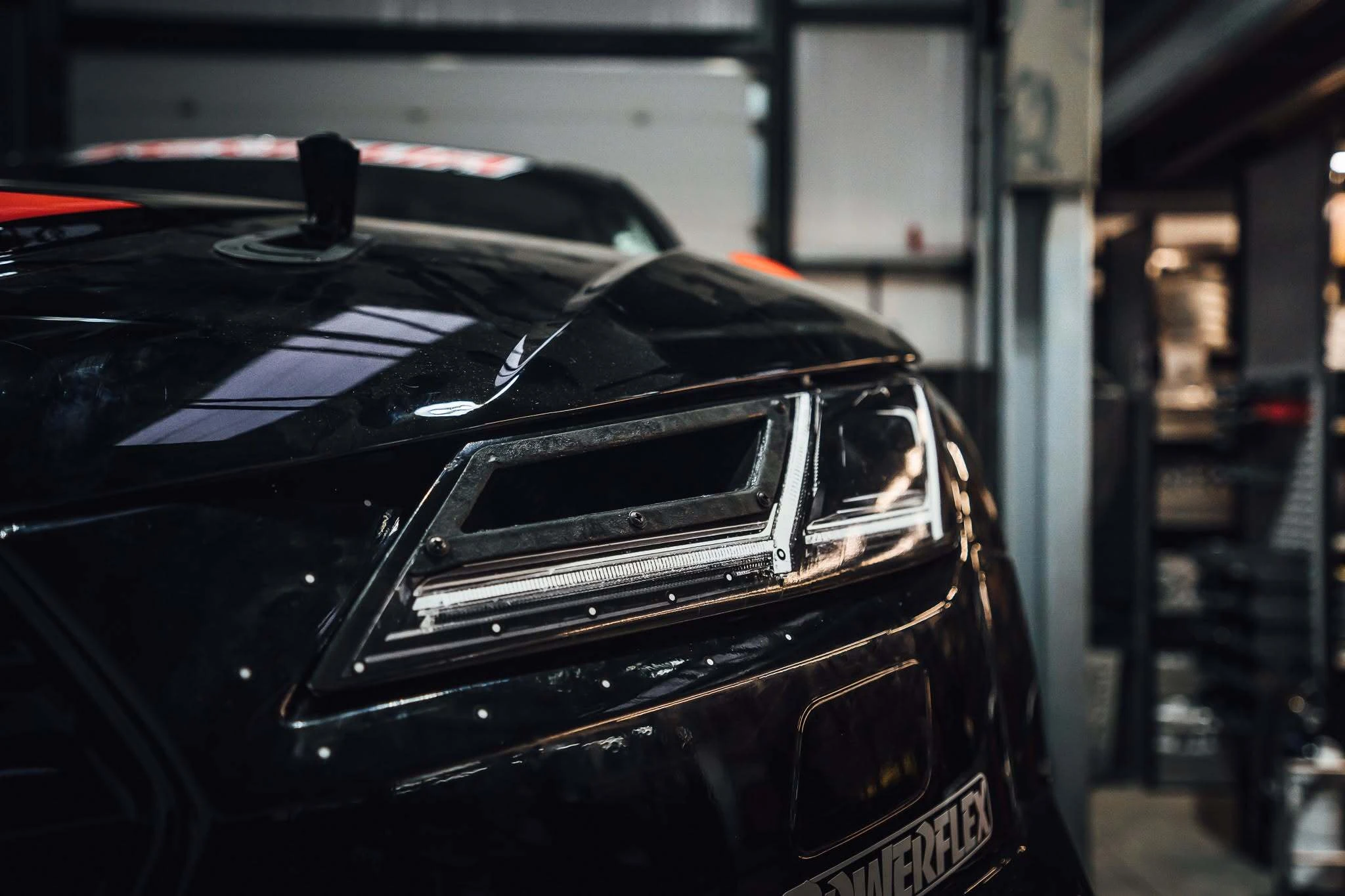
Motorsport also provides us with an extremely demanding testing environment. Components can be subjected to sustained temperatures, loads and stresses that are difficult to replicate through normal road use, giving us valuable feedback on our designs and manufacturing methods. This testing gives us the confidence, experience and measurable data required to offer proven products to our customers.
Countless hours of research and development have gone into our Motorsport division over the years. We test, learn, improve and then move on to the next challenge.